
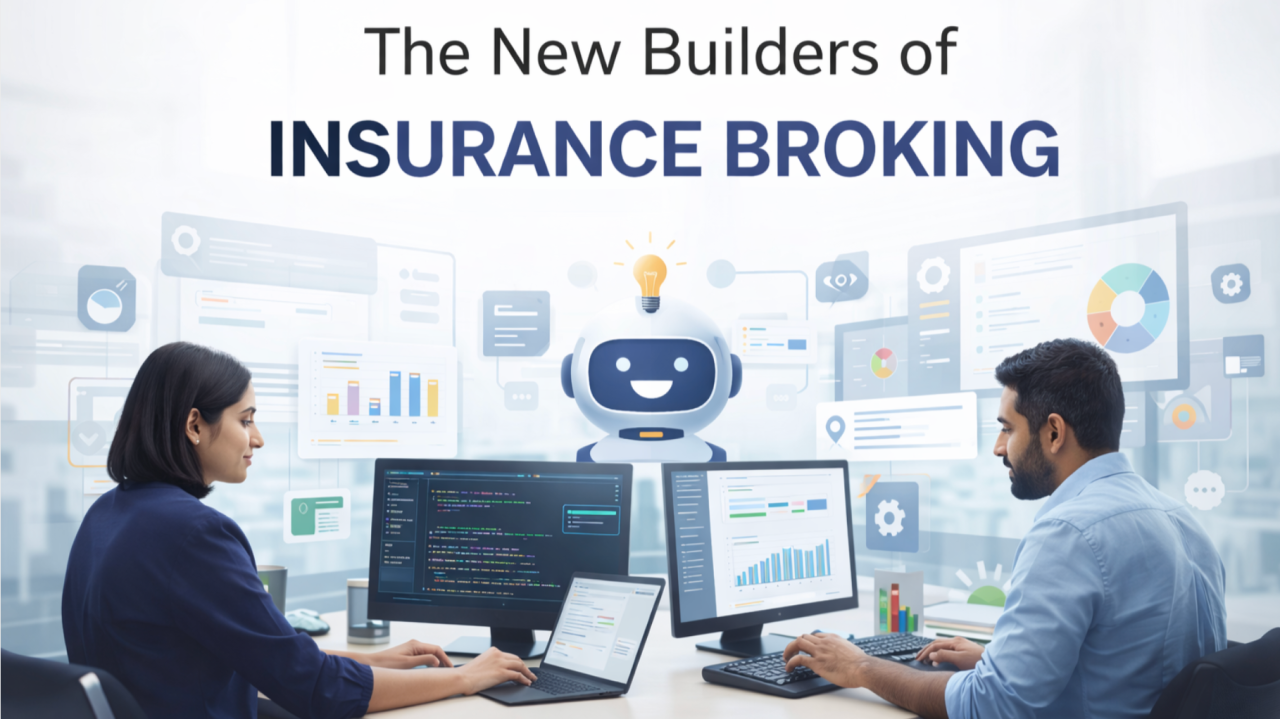
In insurance broking, the teams that outperform are not always the biggest.
Very often, the winners are the teams that move faster, adapt faster, and solve small operational problems before they become large business bottlenecks. In my view, one of the biggest hidden drivers of that advantage is the presence of citizen developers.
Even if you never spend a rupee on outsourced software, never buy our product, and never work with any technology vendor at all, there is still one conclusion I believe every broking firm should take seriously:
Your firm needs smart citizen developers.
When I was at Microsoft, around the time Satya Nadella announced the company’s major push into OpenAI, the pace of internal change was extraordinary. My team and I were quickly moved under Azure’s Business and Industry Copilot efforts, and around that time I started hearing a term that stayed with me: citizen developers.
The idea was simple, but powerful.
As AI became increasingly capable of writing usable code, the ability to build software no longer had to remain limited to formally trained engineers. Analysts, operations leaders, managers, and domain experts could now start building highly specific, small-scale tools for themselves and their teams. Not giant platforms. Not year-long IT projects. Just practical software that solves real problems on the ground.
That is where citizen developers come in.
Citizen developers are not necessarily people with computer science degrees. They are the people inside an organization who have strong product instinct, deep understanding of workflow pain points, and the curiosity to turn repetitive work into systems.
You already know who they are.
They are the people who somehow do the work of five others using spreadsheets, clever automations, internal hacks, and relentless process improvements. They are the ones talking about things like MCP, n8n, AI agents, and new tooling before everyone else catches on. They are the people who do not wait for perfect systems. They build around imperfect ones.
And in insurance broking, these people matter enormously.
Because broking is full of edge cases, exceptions, process-heavy workflows, carrier-specific requirements, compliance overhead, servicing gaps, claims follow-ups, reporting chaos, and countless micro-problems that generic software vendors rarely understand well enough to solve. The firms that can empower internal problem-solvers to build lightweight solutions around these realities gain a very real advantage.
Both Tannmay S Gupta and I have played that citizen developer role in the companies we have worked at. So when we saw brokers being slowed down by generic vendors, delayed for months on simple requirements, or forced to compromise because their technology partners could not keep pace with business reality, it became obvious to us that something had to change.
Because if India’s insurance market is going to grow meaningfully, we cannot keep depending on slow, expensive, disconnected software models. General insurance penetration is still far too low, and if we want to move that number, the industry will need more than distribution effort. It will need better internal tooling, faster experimentation, and more people inside brokerages who can turn operational insight into working software.
That is a big part of what we are building at Vaatun.
We believe the future is not just software for brokers.
It is software that helps brokers build their own software.
Our embedded development tooling is designed for citizen developers inside insurance organizations. It gives broking teams an insurance-native environment where they can chat to extend platform functionality, build internal dashboards, create custom reporting, launch client-facing tools, and experiment with new servicing and distribution workflows without waiting endlessly on outside development cycles.
That could mean building ad hoc claims forms, compliance disclosures, specialized customer workflows, internal productivity tools, renewal operations helpers, or campaign-specific servicing experiences. These are often too niche for generic SaaS tools, too expensive to outsource repeatedly, and too insurance-specific for horizontal AI products to get right out of the box.
We want to change that.
The vision is simple:
an AI coworker for insurance broking teams a broker’s tool that helps brokers build broker tools a domain-native layer for turning insurance expertise into working software
In other words, not just another platform.
A system that helps the smartest people inside a brokerage move faster, build faster, and win faster.
And in the coming years, I believe the firms that cultivate these citizen developers best will be the ones that pull away from the market.
Originally published on LinkedIn on March 31, 2026.